
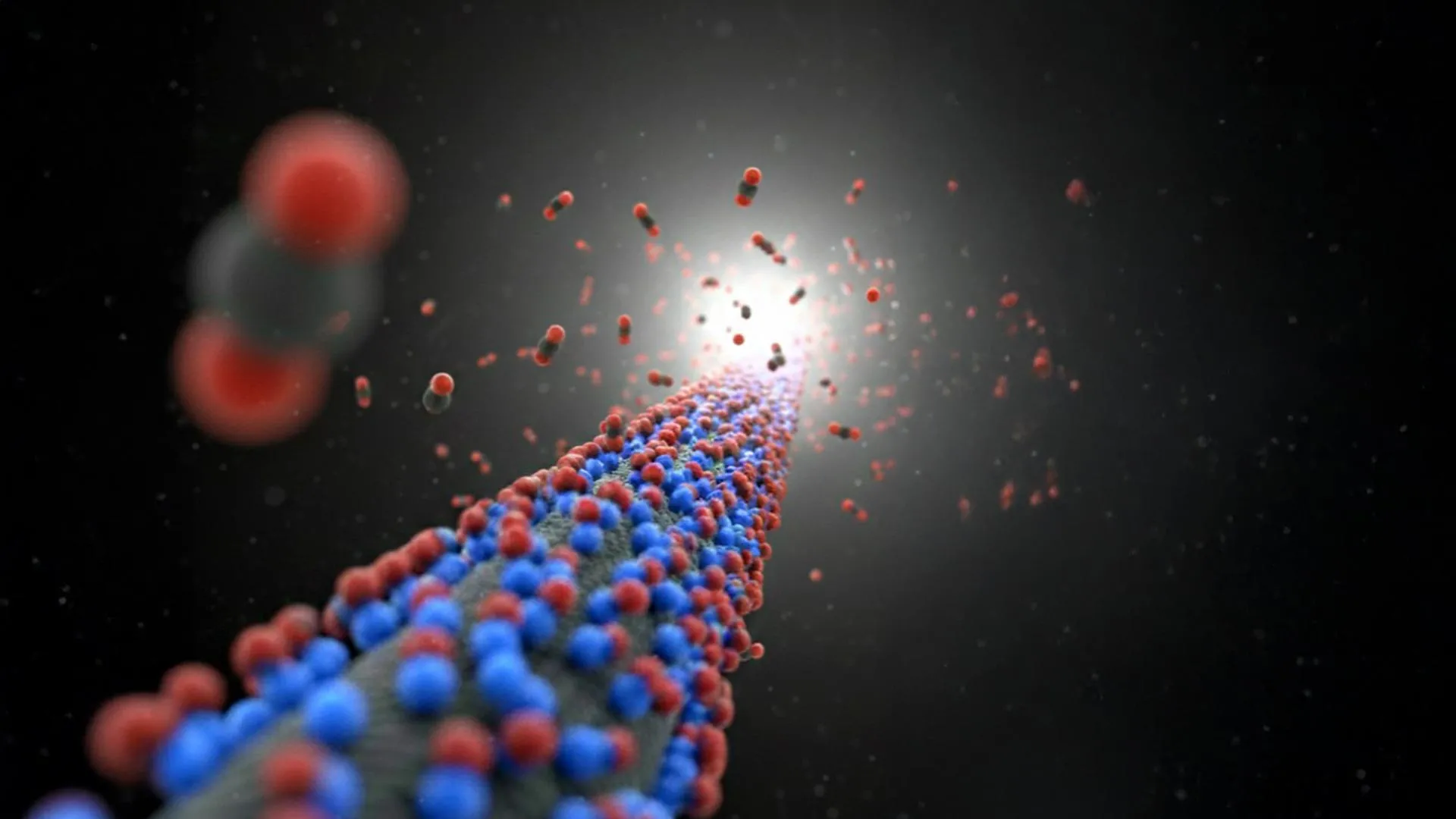




Stopping carbon dioxide (CO2) before it enters the atmosphere is a critical way to cut greenhouse gas emissions. While carbon capture has been around for many years, it has not been widely adopted because most systems are costly and inefficient. A common industrial approach, aqueous amine scrubbing, requires heating large amounts of liquid to temperatures above 100 °C to release the captured CO2 and reuse the solution. This high energy demand drives up operating costs and makes large-scale use difficult.
Solid carbon materials have gained attention as a more practical option. These materials are relatively inexpensive and have a large surface area that allows them to trap CO2. They can also release the gas using less heat, especially when they contain nitrogen-based functional groups. However, there has been a key limitation. Traditional manufacturing methods place these nitrogen groups randomly across the material, making it hard to pinpoint which specific arrangements lead to better performance.
To address this challenge, a research team led by Associate Professor Yasuhiro Yamada from the Graduate School of Engineering and Associate Professor Tomonori Ohba from the Graduate School of Science at Chiba University, Japan, developed a new type of carbon material called ‘viciazites.’ These materials are designed with nitrogen groups positioned next to each other in a controlled way. The study, published in the journal Carbon, was co-authored by Mr. Kota Kondo, also from Chiba University.
Building Viciazites With Controlled Nitrogen Pairing
The researchers created three different versions of viciazites, each with a unique type of neighboring nitrogen configuration. To produce adjacent primary amine groups (-NH2 groups), they first heated a compound called coronene, then treated it with bromine, followed by ammonia gas. This three-step method achieved 76% selectivity, meaning most of the nitrogen atoms were placed in the intended positions.
Two additional materials were produced using different starting compounds. One featured adjacent pyrrolic nitrogen with 82% selectivity, while the other contained adjacent pyridinic nitrogen with 60% selectivity.
Verifying Structure and Testing Performance
Each material was applied to activated carbon fibers to create usable samples. The team confirmed the precise placement of nitrogen groups using techniques such as nuclear magnetic resonance spectroscopy, X-ray photoelectron spectroscopy, and computational modeling. These methods verified that the nitrogen atoms were positioned side by side rather than randomly distributed.
When tested, the materials showed clear performance differences. Samples with adjacent -NH2 groups and pyrrolic nitrogen captured more CO2 than untreated carbon fibers. In contrast, the pyridinic nitrogen configuration offered little improvement.
Low-Temperature CO2 Release Could Cut Energy Use
The most notable finding involved how easily the materials released CO2. “Performance evaluation revealed that in carbon materials where NH2 groups are introduced adjacently, most of the adsorbed CO2 desorbs at temperatures below 60 °C. By combining this property with industrial waste heat, it may be possible to achieve efficient CO2 capture processes with substantially reduced operating costs,” highlights Dr. Yamada.
The material containing pyrrolic nitrogen required higher temperatures to release CO2, but it may offer better long-term stability due to its stronger chemical structure.
A New Path Toward Cost-Effective Carbon Capture
This work shows that arranging nitrogen groups in specific adjacent patterns can be done reliably, providing a clear strategy for designing improved carbon capture materials. “Our motivation is to contribute to the future society and to utilize our recently developed carbon materials with controlled structures. This work provides validated pathways to synthesize designer nitrogen-doped carbon materials, offering the molecular-level control essential for developing next-generation, cost-effective, and advanced CO2 capture technologies,” concludes Dr. Yamada.
Beyond capturing CO2, these viciazite materials could also be used for other applications, including removing metal ions or serving as catalysts, thanks to their customizable surface properties.
Funding and Support
This work was supported by Mukai Science and Technology Foundation, Japan Society for the Promotion of Science (JSPS KAKENHI Grant Number JP24K01251), and the “Advanced Research Infrastructure for Materials and Nanotechnology in Japan (ARIM)” of the Ministry of Education, Culture, Sports, Science and Technology (MEXT) under Grant Number JPMXP1225JI0008.